Ages 6–10 Years 2–5
A Year with My Piggy Bank
Weekly pocket money, a piggy bank and first decisions: a lolly or saving? Is my change right? Should I lend to a friend?
Play: A Year with My Piggy BankFree · no sign-up · no ads · no tracking
A comic-style game in which children and teenagers try out a year with pocket money: saving for their own goal, lending to friends, sales, ‘pay later’ and scammers. Every decision has consequences in the months that follow — and at the end the game shows where the money went.
Weekly pocket money, a piggy bank and first decisions: a lolly or saving? Is my change right? Should I lend to a friend?
Play: A Year with My Piggy BankMonthly pocket money, a first card, rainy-day money and traps: Black Friday, a ‘free’ subscription, a fake parcel text, ‘Hi Mum, new number’.
Play: A School Year with Pocket MoneyTheir own account, a part-time job, contracts and first debts: a phone contract, ‘pay later’, a fake bank call, guaranteed returns.
Play: A Year with My Own AccountThe game runs in the browser on a phone, tablet or computer, and one round takes about 20–30 minutes. Nothing to install, and the browser remembers a game in progress.
First you pick a character, set the pocket money to match what you give at home and choose what to save for — a bike, a console, a course.
A comic shows what happens: a friend wants to borrow, an online shop counts down a sale, ‘the bank’ calls. Then it’s time to decide.
Money comes in or goes out, a debt is paid back from the next pocket money, a subscription keeps being taken until it’s cancelled. The money card shows what’s there, what’s coming and what’s owed.
At any time, and at the end of the year, the game shows where the money went and which decisions cost the most — and suggests questions to talk about at home.
No game teaches anyone to manage money in an afternoon. This one lets children try decisions out for pretend — before they make them with real money.
A mistake in the game costs nothing. So you can try what would hurt in real life — and see why.
Small buys add up, instalments eat into future pocket money, rainy-day money saves a cracked screen. You can’t see that in one situation, but you can over a whole year.
Countdown timers, ‘free for a month’, a link in a text, guaranteed returns, ‘Hi Mum, new number’. The game shows them the way UK public bodies such as the National Cyber Security Centre, the Financial Conduct Authority and the Competition and Markets Authority describe them.
There are no points or rankings at the end — just an overview of where the money went, and questions you can talk about with your child.
The games link to the national curriculum in England: money and giving change in primary maths, percentages and simple interest at key stage 3, and in citizenship budgeting and managing risk (key stage 3) and income, credit and debt, insurance and savings (key stage 4). Citizenship is due to become statutory at primary too, with the new curriculum taught from September 2028.
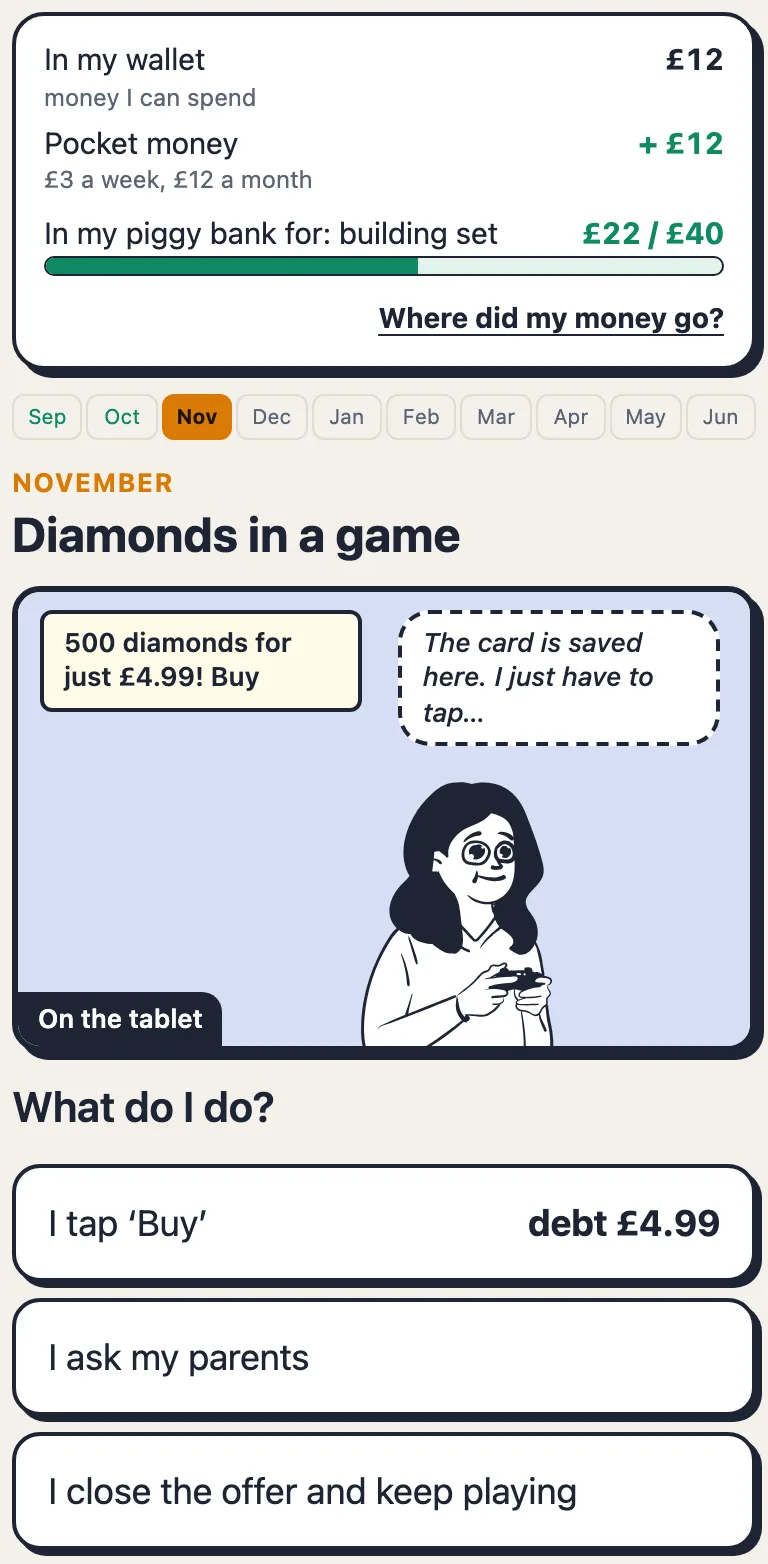
Ages 6–10 · Years 2–5 · 10 months, September to June
Weekly pocket money, a piggy bank and first decisions: a lolly or saving? Is my change right? Should I lend to a friend?
Short sentences and bigger text. Younger children get the most out of it with a grown-up.
Play: A Year with My Piggy Bank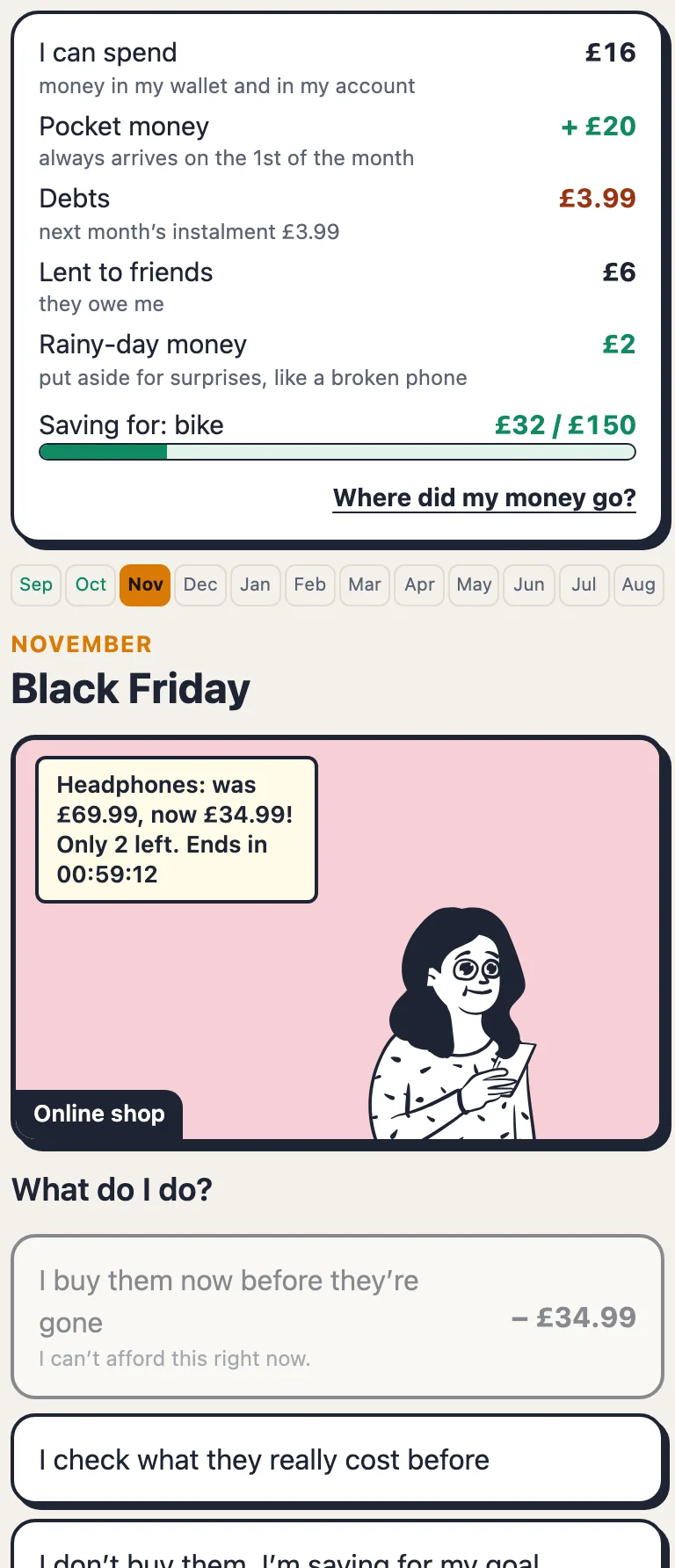
Ages 11–15 · Years 7–10 · 12 months, September to August
Monthly pocket money, a first card, rainy-day money and traps: Black Friday, a ‘free’ subscription, a fake parcel text, ‘Hi Mum, new number’.
The situations link up: what is decided in September comes back in November.
Play: A School Year with Pocket Money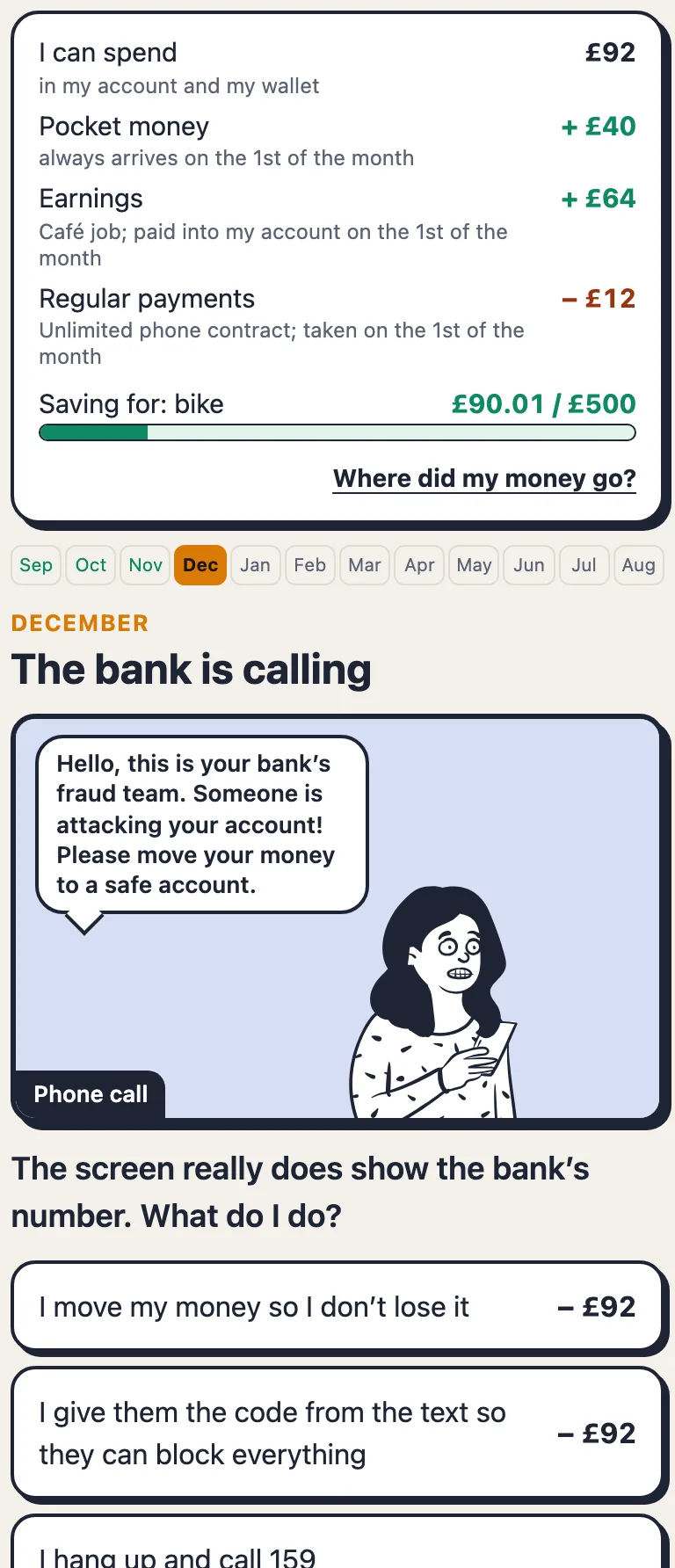
Ages 15–18 · Years 11–13 · 12 months, the year before turning 18
Their own account, a part-time job, contracts and first debts: a phone contract, ‘pay later’, a fake bank call, guaranteed returns.
The game doesn’t work out tax or National Insurance on part-time work — it points to HMRC.
Play: A Year with My Own AccountThe situations aren’t made up out of thin air. Each one is based on an official UK source, linked in the game. Characters, names, shops and amounts are made up. The game follows the curriculum and the law in England; in Scotland, Wales and Northern Ireland schooling and parts of the law differ.
Citizenship key stages 3 and 4 and mathematics: budgeting, managing risk, credit and debt, insurance, savings, simple interest, money and change.
Forwarding scam texts to 7726, reporting fraud, and calling 159 to reach your own bank safely.
Money mules: what it is and what it can lead to.
Investment scams and the Firm Checker, Buy Now Pay Later rules, deposit protection up to £120,000, the 2% inflation target.
Consumer Rights Act 2015, Digital Markets, Competition and Consumers Act 2024, Theft Act 1968, Working Time Regulations 1998 and GOV.UK guidance on child employment.
Links go to the public websites of public bodies and other authors. The game doesn’t work with them and wasn’t made with their support; nothing is copied from their texts.
Character drawings: Open Peeps by Pablo Stanley (public domain, CC0).
The games are for children, so they are built to know nothing about them.
The game doesn’t ask for a name, email or age. The character and the goal stay in the game.
Neither the games nor this page load any analytics, advertising or other third-party scripts, and there’s no cookie banner because there’s nothing to ask about.
Progress is saved in the browser’s storage on the device, not with us. The ‘Play again’ button deletes it.
The game pages give the browser a rule (Content Security Policy) that forbids them from sending anything to any server. So it isn’t just a promise.
Like any website, the server that runs these pages briefly logs technical details of requests (such as the IP address) for operation and security. We don’t use them to measure traffic and don’t link them to anything. Privacy
Yes. The game is free, with no ads, no in-game purchases and no sign-up. Nothing is sold or offered in it.
For children and teenagers aged 6 to 18, in three versions: A Year with My Piggy Bank for ages 6–10 (Years 2–5), A School Year with Pocket Money for ages 11–15 (Years 7–10) and A Year with My Own Account for ages 15–18 (Years 11–13). The age ranges aren’t strict — choose by what your child already does with money.
One round takes about 20–30 minutes. You can stop at any time; the browser remembers the game and offers to carry on next time.
No. There’s no sign-up, no cookies or analytics, and sending anything is technically blocked. A game in progress is saved only in the browser on the device.
The situations link to the national curriculum in England — citizenship and maths. At the end of the game there is a list of the curriculum areas they touch on.
The game doesn’t punish it or award points. It shows the consequence — less money, a new debt, the goal moving further away — and explains why. Those are exactly the moments worth talking about.
Yes. It runs in the browser with no accounts and no installation, and one round fits into a lesson. At the end there is a list of curriculum areas and the sources for the situations.
The game is run free of charge by Assetli. We don’t offer or promote anything in the game or on this page, including our own service.
Choose the game by your child’s age. One round takes about 20–30 minutes.