Property check
before you buy
Open a listing and the add-on turns it into a protocol: twenty-five checks, each with a status, a reliability grade and its source. What we do not know, we say — silence is never sold as “fine”.

Three checks without an account. Nothing is injected into the page; the add-on reads the listing only when you click.
What the protocol checks
The things that can be verified from public sources — the ones buyers usually chase one office at a time.
Land registry and legal status
Title deed: liens, easements and notes. The parcel, its area and land type. The seller in the insolvency register by company ID or name.
Risks of the place
Flood zone (active zone and the 100-year flood), radon index of the bedrock, recorded landslides, noise and amenities nearby.
Zoning plan
Which zone the parcel sits in. Where the municipality is not in the national geoportal yet, the add-on finds the plan on its own website and offers the main drawing too.
Price and financing
Price per m² against prices actually paid in the district, the mortgage payment at today’s rate, what a rate two points higher would do, and the total monthly cost of ownership.
What it looks like
Five panel screens as you see them next to the listing. Real screenshots, not drawings.
The short answer
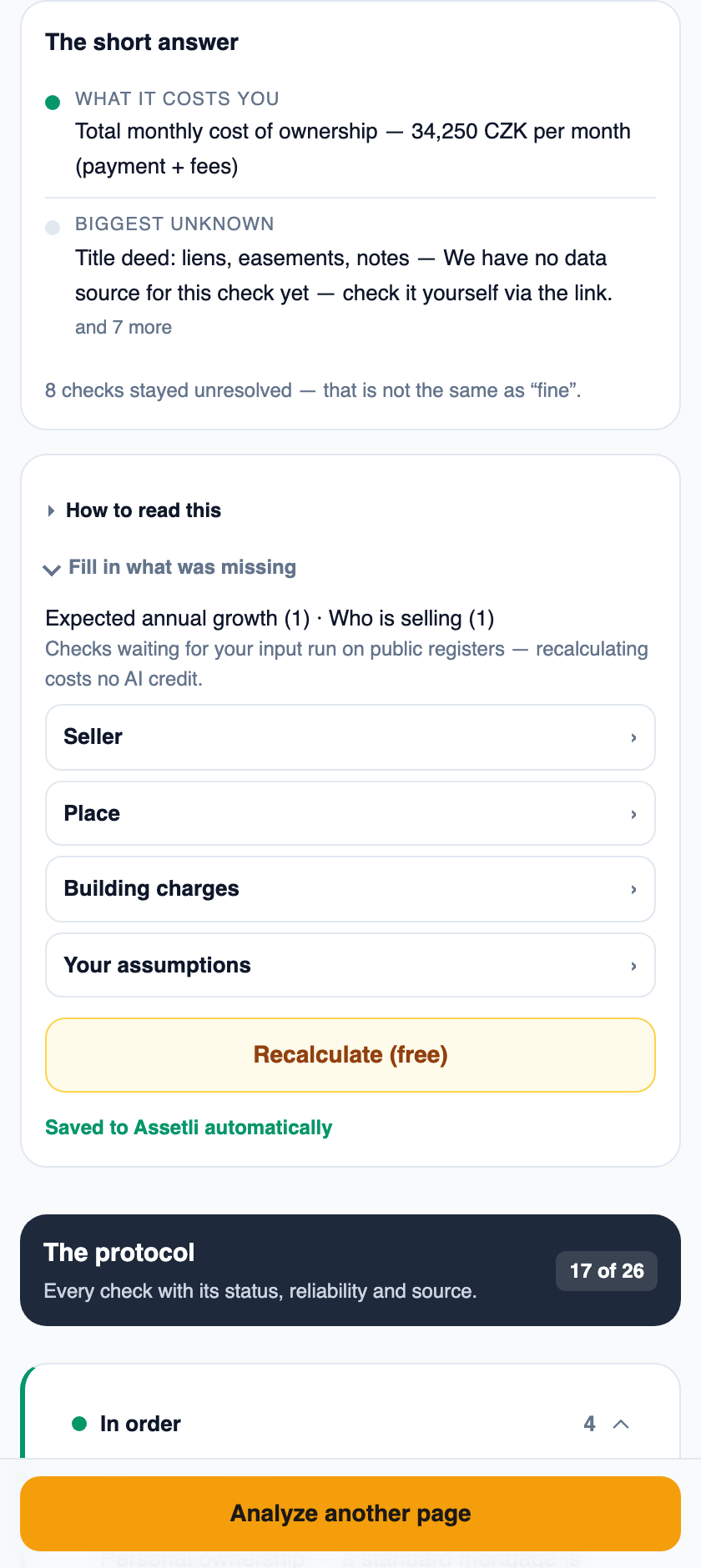
What it will cost you per month and what the biggest unknown is — before twenty-five items.
The protocol with sources
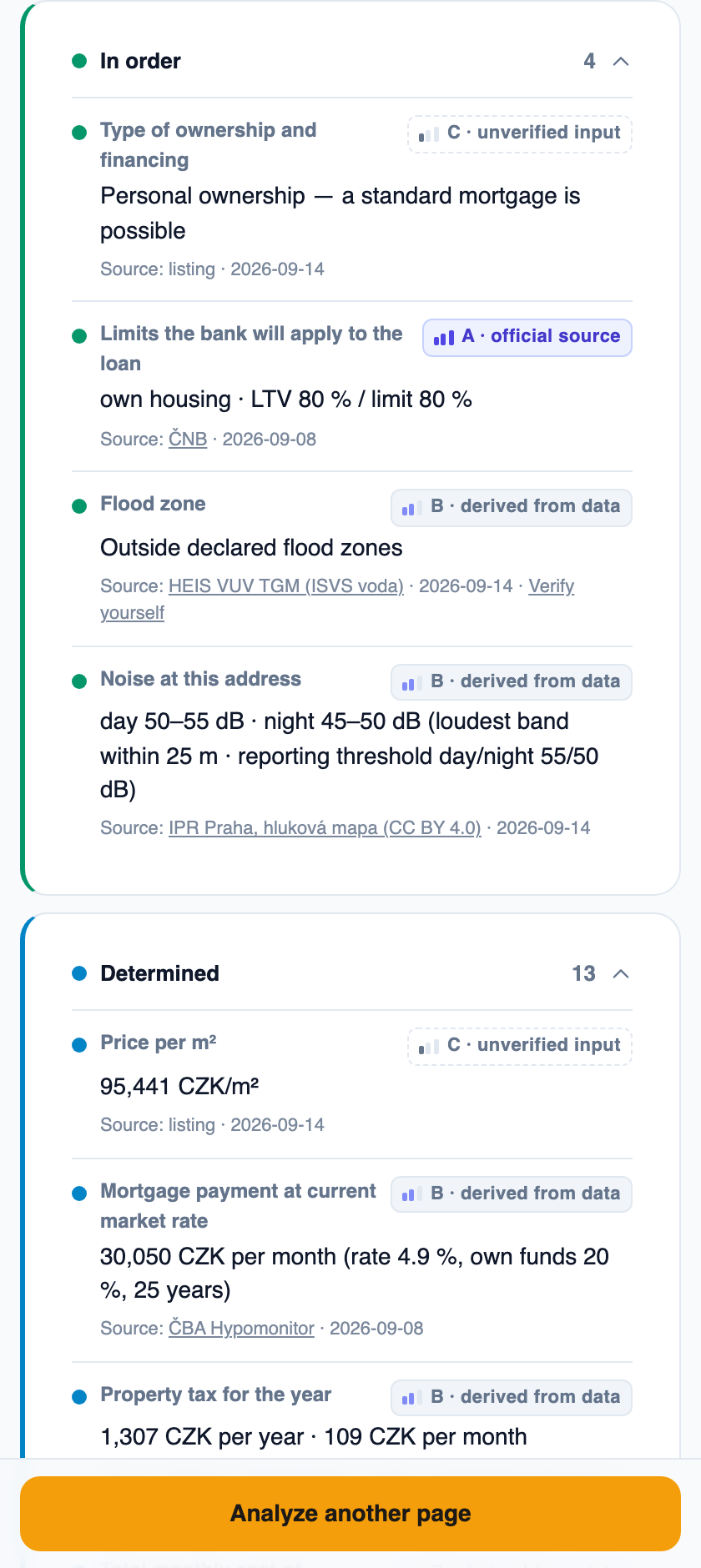
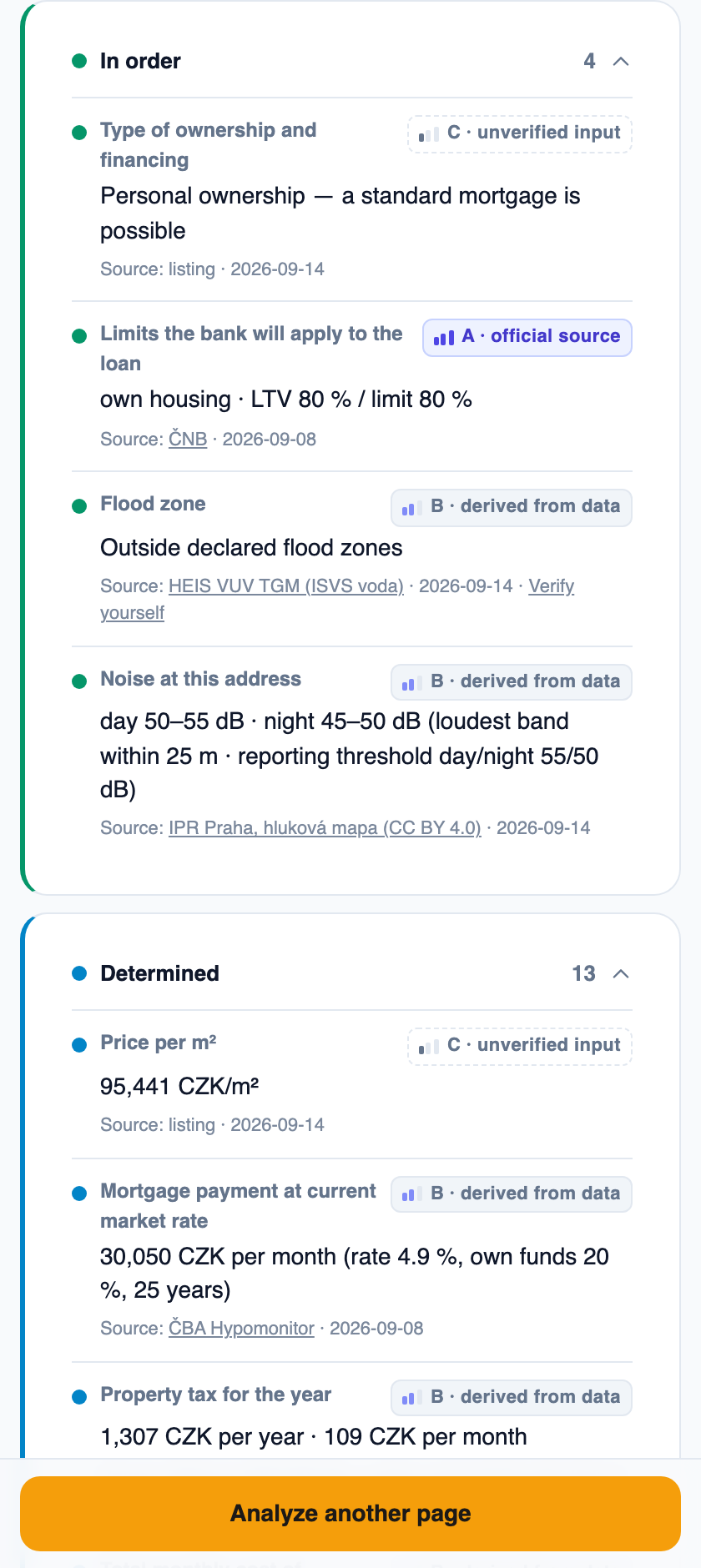
Every check with a status, an A/B/C reliability grade and a dated source.
What we do not know, we say
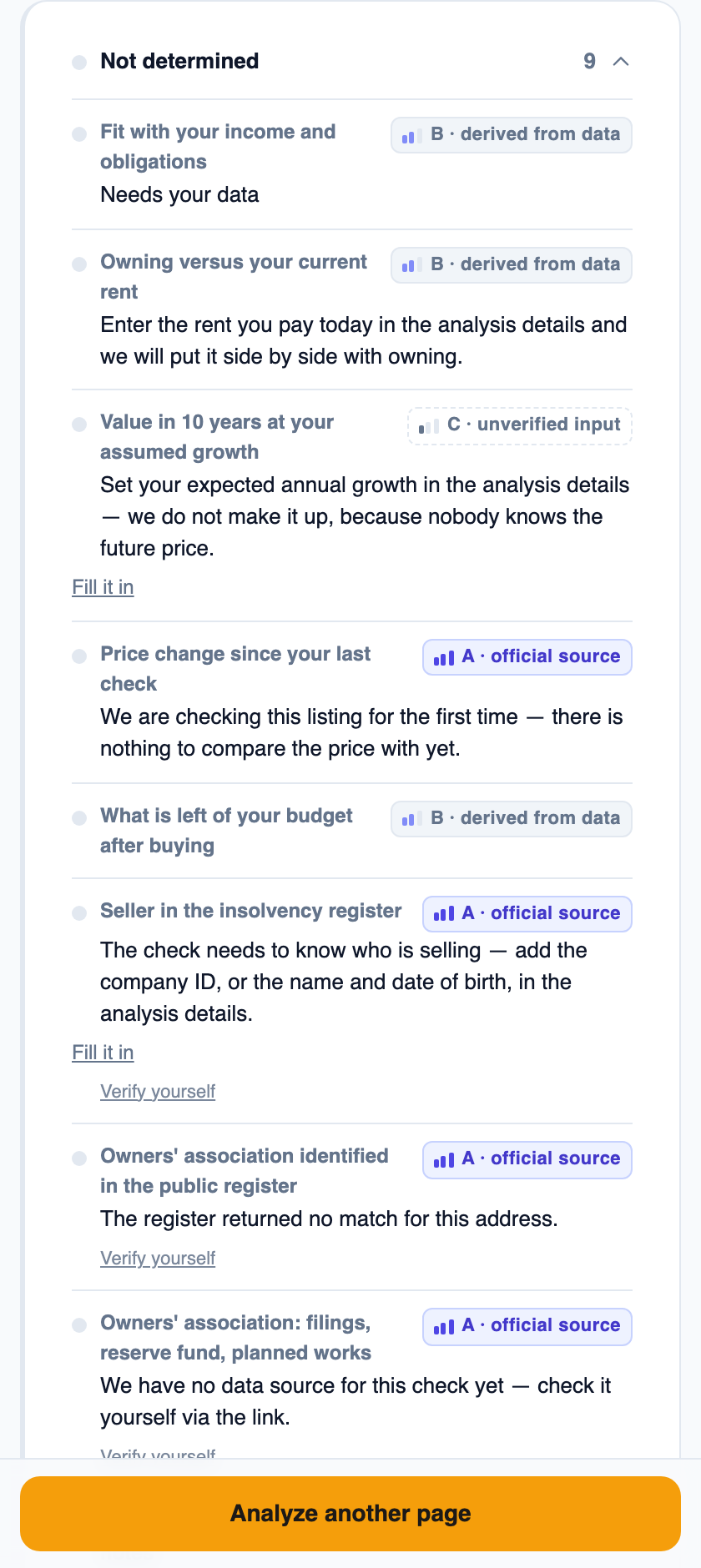
Unresolved is not “fine”. Every gap states why and where to verify it.
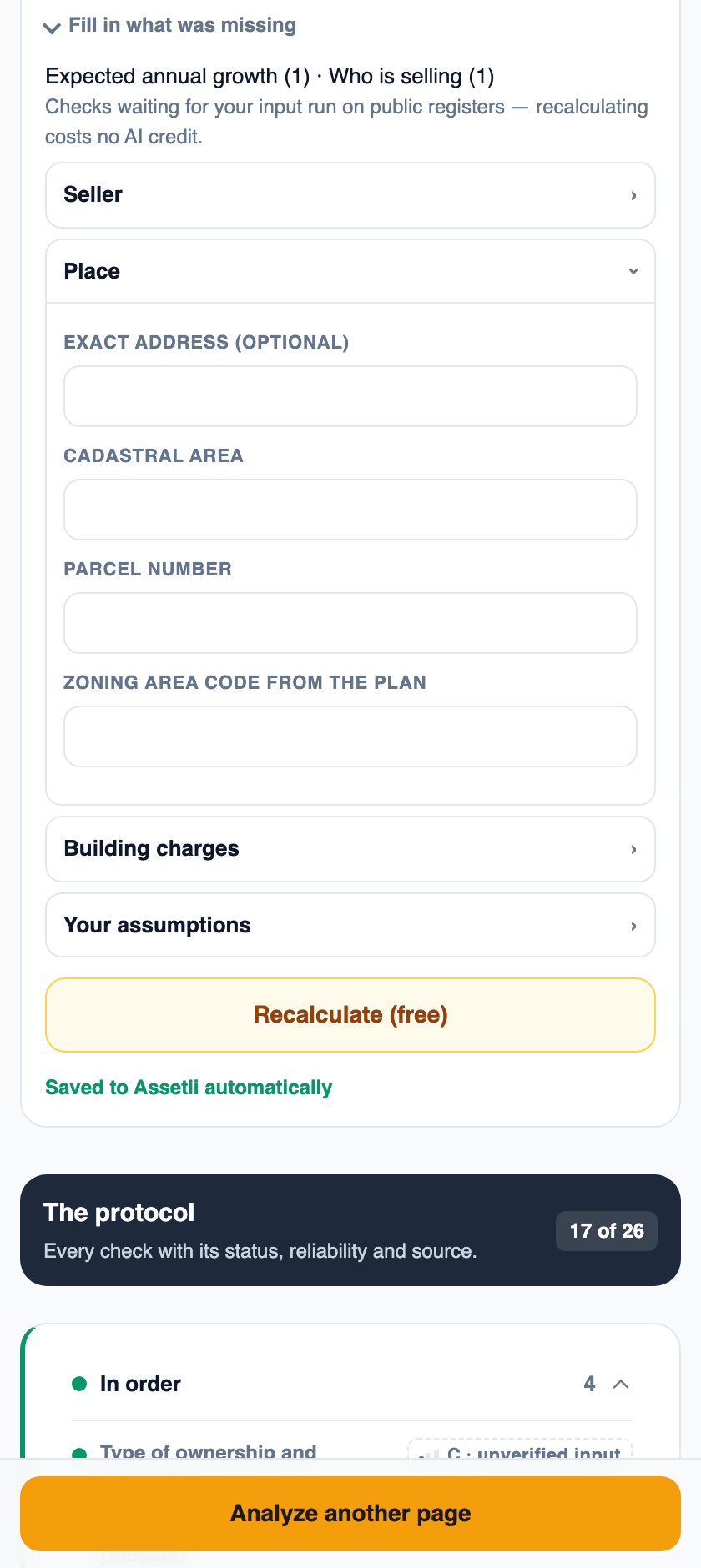
Filling gaps is free
Add a company ID or an address; recalculating costs no AI credit.
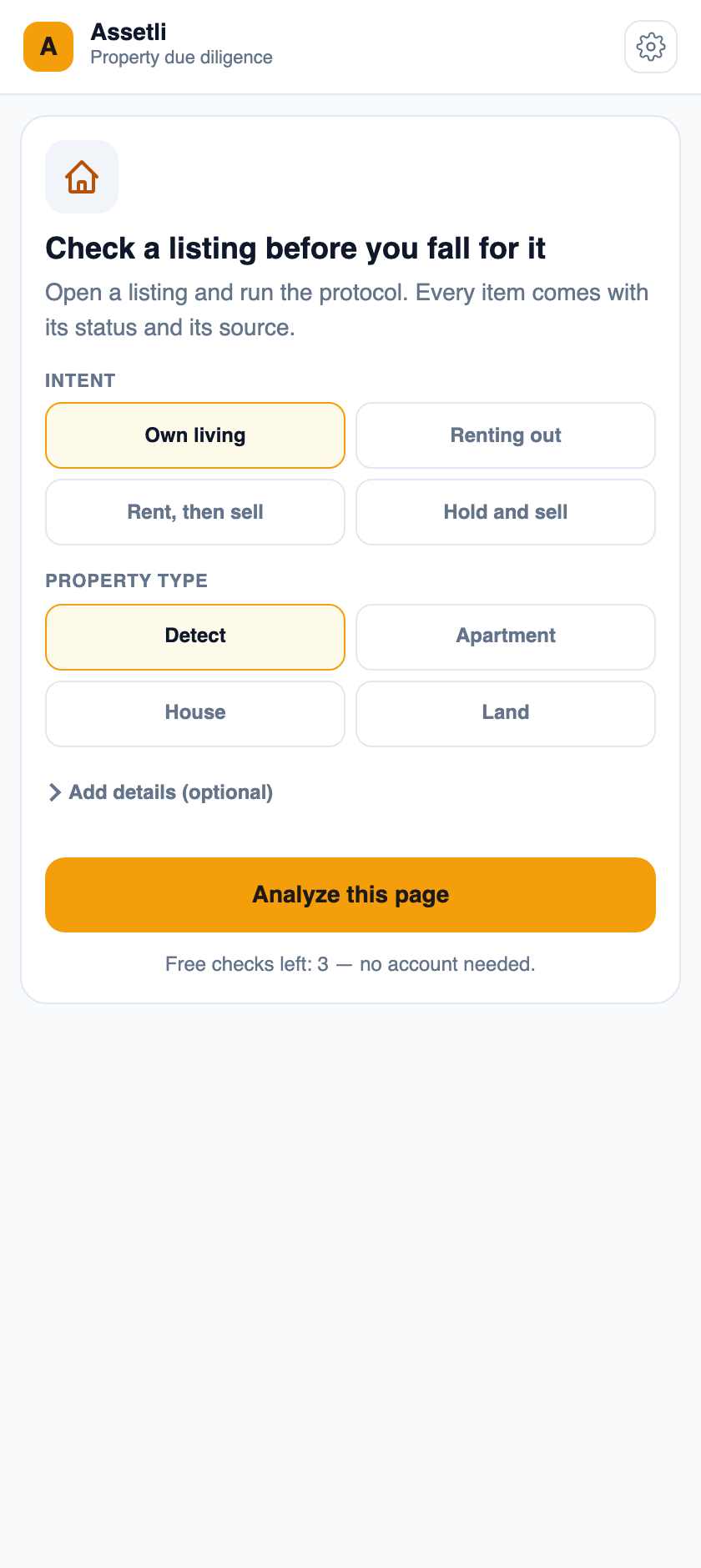
Starting at the listing
Intent, property kind and the price up front. Three checks without an account.
How it works
- 1
Open a listing
Any property portal in the world. The add-on asks for access to the site the first time you click its icon there.
- 2
Click Analyse
The panel beside the listing reads the page text and sends it to be checked. It takes tens of seconds.
- 3
Read the protocol
The short answer first — what it will cost you per month and what the biggest unknown is. Then every check with its source.
What we do not know, we do not claim
Estimating tools always produce a number. A due-diligence protocol also tells you what nobody looked at — and why.
Every item has a source and a date
Cadastre, statistical office, flood and geological services, the zoning geoportal, the insolvency register. Each finding carries a link where you can verify it.
Reliability A / B / C
A is an official source, B a computation from data, C an unverified input from the listing. The difference is visible at a glance.
A gap says why
Whether the source was silent or it is waiting for your input. Seven in ten unresolved checks unlock when you add the address or a company ID — and recalculating is free.
The AI assessment is separate
Facts and the model’s opinion never mix. The assessment is labelled an opinion, not advice.
Where it works
The add-on handles a listing from anywhere. The depth differs, and it is only fair to say so up front.
Czechia
The most detailed. The protocol answers roughly three quarters of the checks from official sources — cadastre, statistics, flood zones, radon, zoning, insolvency.
The rest of the world
Price, financing, location and surroundings are computed everywhere. For checks we have no source for, you get a link to the authority in that country where you can verify it by hand.
What it costs
Three checks without an account
Free, no sign-up. A protocol from public sources, wherever you are.
With an Assetli account
Saved analyses, comparison, the AI assessment and the “what is left of your budget after buying” calculation from your real numbers. A free account includes a monthly AI allowance; the price of every step is shown before you click.
Frequently asked questions
Is the property check free?
Three checks without an account are free. A free Assetli account includes a monthly AI allowance covering a few more protocols; heavier use needs a paid plan or topping up credit. The price of every step is shown in the panel before you click, and recalculating after you fill in a detail is always free.
Does the add-on read my browsing?
No. It reads the text of one page, and only at the moment you click Analyse. Nothing runs in the background, no website is pre-approved for reading, and the add-on does not track what you do in the browser.
Which property portals does it work on?
Any site with a listing. The first time you use it on a given site, Chrome asks whether to grant access to it.
Does it replace a lawyer or a surveyor?
No, and it does not pretend to. The protocol collects what public sources hold and shows where the gaps are. It replaces neither a legal review of the contract nor a survey of the building — but it tells you what to ask them about.
Where does the data come from?
Public registers and open data: the cadastre, the business and insolvency registers, the statistical office, flood and geological services, the national zoning geoportal and OpenStreetMap. The source and date stand next to every finding.
Do I need an account?
Not for the first three checks. An account adds saving, comparison, the AI assessment and the after-purchase budget from your own numbers.
Check the listing before you fall for it
Installing takes seconds. So does the first check.